Follow awfulagent on Twitter

About Me

A blog wherein a literary agent will sometimes discuss his business, sometimes discuss the movies he sees, the tennis he watches, or the world around him. In which he will often wish he could say more, but will be obliged by business necessity and basic politeness and simple civility to hold his tongue. Rankings are done on a scale of one to five Slithy Toads, where a 0 is a complete waste of time, a 2 is a completely innocuous way to spend your time, and a 4 is intended as a geas compelling you to make the time.

Friday, July 31, 2009

Manilla Extract (My Life in Technology, Pt. 3)

So as I've mentioned in my posts this week, I've been taking on new clients very selectively.  And things have been going well enough for most of my long-time clients that I've usually been doing new contracts with current publishers.  I think it's possible that my last major multiple submission was over three years ago when I sent out Adam-Troy Castro's Emissaries from the Dead.

My, but the world has changed a lot since then.

Most major publishers have now given staff Sony Readers or other such things to do their reading on.  Pretty much everyone takes submissions electronically.  An entire big multiple submission was done without a single piece of paper.   And I read multiple drafts of the manuscript on my Kindle and the final little tweaks just looking for the track changes on my computer. 

Once upon a time, everything was on paper.  In the early years of JABberwocky, I would even do my own deliveries.  It saved an awful lot on postage.  It saved even more because a manuscript going through the mail needed a padded envelope while a manuscript which I delivered could get put into a cheaper manilla/brown kraft clasp envelope.  It got me out of the house for a few hours.  I was a young and energetic thirty-something and the bag would keep getting lighter as the manuscripts were dropped off.  It was a triple win scenario.

Now, I find myself thinking I should get faster broadband so the 1.6MB file can go out to an editor a few seconds more quickly.

But the problem is that I have these boxes of 11.5x14.5 manilla envelopes that I purchased pretty much for the soul purpose of having around to put in manuscripts to hand-deliver to publishers.  And now they're all going as electrons instead of as dead trees, so what am I going to do with 200 11.5x14.5 manilla envelopes?

On the other hand, because we don't have authors mailing us manuscripts very often, we find that we don't have enough small boxes.  We get big boxes of books from publishers, but if we want to mail a small box of books to an author...

Another part of this is the way that labor is transferred to different places.  I used to get royalty statements and contracts for foreign rights deals in the mail, ready to go into the file or off to the author.  Now a lot of these come in to me electronically, and I have to do the downloading and printing.  A few US publishers are starting to send me PDF files for contracts so they no longer print out as many and I print out more.  Some of these, I may e-mail in turn to the author, who now has to print out contracts that the agent used to print out.  But on the other hand often no longer has to print out a manuscript for agent to read.  And I now get to send manuscripts to the publishers electronically, so some publishers may trade printing out 4 copies of a 14 page contract for printing out chunks of a 497 page manuscript.

There's probably a doctoral dissertation in all of this, trying to identify the ultimate winners and losers from this giant shuffle in the publishing paperwork dance.

But there's no denying that I have hundreds of 11.5x14.5 manilla envelopes that I currently see no possible use for.

The times they are a changing!

Thursday, July 30, 2009

Son of Dead KIndle


So now I have 2 broken Kindles.  Notice that nice horizontal line across the top of my Kindle when turned off.

Everything else works fine.  I can watch the pointer line on the side go up and down when I restart or turn my Kindle on or off.  I can use the USB connection.  But the Kindle is dead.

So what does one do?

They want $180 to send me a refurbished Kindle, plus shipping.

I don't want to send them $180.  I've gone through two of them now in 15 months.

I don't want a Sony Reader. I don't like the screen and the glare and the note-taking isn't good and intuitive as I need it to be.  I like the wireless subscriptions on my Kindle.  And the other thing is that all of my problems have been with the screen, and all the screens on all the e-readers use the same basic E Ink technology so I'm not sure I trust any of them right now.

I don't want to go back to reading manuscripts on paper.

I didn't do anything to the Kindle yesterday.  It was fine in the morning when I turned it on to get my newspapers.  I just walked around with it some in my backpack.  And then this morning the screen is Dead Again.

I was planning to go away for the weekend but hoped to get some reading done while I was away.  I just don't want to  have 3 manuscripts to print out and cart around, not that I'd get to reading 3 but just in case I bail out of #1 there's got to be some backup.

I'm feeling terribly addicted right now, when I know I shouldn't spend money on something because it's going to be bad for me, and yet I'm not sure I can stop myself from it.

What I really want to do is find a class action attorney, I think, maybe talk to the one who's suing over the case cracking on the Kindle 2.

Update #1:  The $180 refurbished Kindle comes with but a 90-day warranty.  A used Kindle is available currently on Craig's List for $140-$150, in the low $200s for a Kindle 2.

Update #2:  I have downloaded the Stanza app for my iPhone, and I am busily transferring content to my iPod Touch.  This isn't as good as the Kindle, but maybe my iPod touch won't break every few months... 

Update #3:  A Washington Post subscription via Newspaper Direct if purchased in advance costs less than a Kindle subscription.  A Wall St. Journal subscription for a first-time subscriber can be nicely discounted for a whole year over the Kindle price.  I don't like being chained to my computer to look at them, but none of them require me to buy a $180 or $300 device that keeps breaking down, and which doesn't work so well in cold weather in NYC for six months of the year, and etc.

Wednesday, July 29, 2009

Son of New Kid

I posted yesterday about some of the new things going out to market this week, and I thought I'd give a post geared to people who might have similar hopes for manuscripts on my reading pile, where the eldest manuscripts have been almost six months in repose. Which nags at me no end.  Especially since some of these people are friends, or people we at JABberwocky have been grooming.  Or are ignoring me when I remind them that I don't demand exclusives and are kind of patiently waiting for Joshua Bilmes to read and respond.

I'd like it if my life were full of perfect first drafts, but it's not.

I'd like it my days were full of time to sit down and read manuscripts.  But they're not.  The work day can push well past 6:00 some nights, and then by the time I have gym time and eat dinner or finish the newspaper it can be 10PM and I'm just not up to tackling reading, and if I was, I wouldn't be receptive to what I was reading anyway.  Even though I've cut way back in recent years on some of my movie-going and other extracurriculars, it's still harder and harder most weeks to get to reading manuscripts.  And I do need some non-work time in order to continue as a functioning sane member of human society. Maybe I could cut back on blog posts (and in really busy months I don't do many posts), but these days having a blog or a Facebook page or what-not is kind of part of what people do.  Maybe I could give up reading newspapers except I am an addict.  Or give up my New Yorker or Rolling Stone, but it's kind of a good idea to have some idea of what's going on in different parts of the world.  So reading time ends up being scarcer than I would like.


Hence, there's this kind of air traffic control or triage with the reading pile.  So first priority... A client turns in a manuscript that's already been sold to a publisher and that needs to land first because it's already sold, there's a delivery check waiting when the manuscript gets turned in, and often the project is already scheduled so editorial work needs to be done in a specific time-frame in order to meet the publisher's production schedule.  And sometimes I'll read that manuscript a second time or sometimes not, depending on the extent of the revisions and whether or not the production schedule has any give in it for more agent revisions.  Then I'll come across something like Stung that's not under contract but which is from an actual current selling agency client, so that will get slotted behind a contracted-for manuscript but ahead of most anything from a non-client.  And then I'll finally have a moment to read something from a non-client like Latent.  And then there will be the next drafts of a Latent or Stung.  In the case of Latent and Stung, I knew both manuscripts were very very close to going to market, so those had priority over first drafts on the slush pile or some second drafts for things that I know have potential but which aren't quite as close to going to market. 


With Latent and Stung off to market, I have one more third draft of something which I think is very very close which I've decided to put ahead of everything else.  And then after that, for the first time in several months, it looks like I can start to tackle the February manuscripts.  And because those have been here so long, I feel a need to get to some of them over manuscripts that came in May which are theoretically more important but which if I read now could turn somebody else's six-month wait into an eight-month.


And even then there are decisions to make.  Since I'm going to LA this month perhaps I should read the manuscript from an author in LA before I head out, in case we'll have something to discuss.  But if I can't get everything read before the trip, what does that mean for an author who may have turned in a manuscript two weeks sooner but may now wait four weeks longer for a response?


In  part I'm able to get caught up because summer is often slightly slower at JABberwocky.  June and July can be very slow months for publisher payments which means less time spent on processing those.  Many editors in the US will go to ComicCon or on vacation, so I have fewer people to talk to.  Europeans can take long summer vacations so the foreign rights business will slow up.  How much reading time will I have before things get busy again?


If I really like one of these February manuscripts but need to do that revision thing, then it could be that I'll have only four or six weeks while an author revises and then have a second draft for a February manuscript that will get slotted ahead of some April manuscript.


I don't like this, but I'm trying as best as I can to do things as quickly as I can.


And FYI, as bad as things are here...  Some editors have always been very slow, and I sympathize more and more.  In 2009, many publishing houses have had layoffs or hiring freezes as a result of the economic situation, and so they are trying to do more with less.  Which is not always possible, which is making an editor's life a little bit harder.  

Tuesday, July 28, 2009

The New Kid in Town

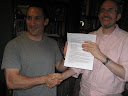
So on Saturday I took on a new client for the first time this year, an author named Myke Cole, here depicted doing the official photo op exchange of signed representation agreements for LATENT.


When I started my own literary agency in 1994, I could afford to take on things that were OK that I might be able to sell because I had a lot of time on my hands and had to do something with it.  As the years progressed, the bad news was that I got choosier and choosier about what I might agree to represent, the good news that my track record for actually selling the things I took on increased quite a bit.  So needless to say, I am taking on Myke's Latent because I like it quite, quite a bit.  It's a mix of military sf and fantasy that's different from pretty much anything else but very accessible to just about any sf/fantasy fan.  Joshua proposes and editor disposes, and time will tell how many publishers will come to share my enthusiasm.


A few things worth mentioning about the process...


It's not what you know, it's who you know.  Myke swears to introducing himself to me at a SFWA NYC Editor/Publisher reception many years back, and I'm sure he did, but I first remember meeting Myke at Philcon in 2003.  But this is definitely an example of putting a convention to good use, doing some networking, making contacts, etc.  


It isn't always quick.  December 2003 to July 2009 means it took something like 67 months from first meet to having an agent.


The people who get an agent and sell their actual first novel are probably the lucky ones.  In some ways Latent can be seen as Myke's first novel because the first thing I read of Myke's was a very early very different novel with the same title, the same concept in very general terms, the same name for the lead character.  But really, this novel is nothing like that.  And there are two other partials that I read which I flat-out rejected in the meantime.


Revision is part of the process.  When I finally read this version of for the first time, I liked it quite a bit.  But there were two substantial revisions that followed, and then a few rounds of little smaller tweaks.  The book was shortened considerably.  The final major changes included a completely new beginning and some major scene changes in the middle.  Excess POVs were removed.  The final small changes included some things that were informed by the thought process on the second book in the series, where it seemed to make sense as that outline came together to add a thing or two to better set up the next book.  All of the things I did with Myke are in broad strokes things are common parts of a good revision. Myke didn't do every single thing I asked of him, but where he was really set on doing something one way we had a really good hash out on it.  I tried to be respectful of what he wanted to accomplish in the book, but he was professional enough to recognize when I had the better argument on something.


And when it comes to revision...  We recently sold a book called THE STAR SHARD by Fred Durbin.  I had the author do a major rewrite when it first came in.  Afterwards, because I had decided my assistant would take command of the YA/middle-grade business at JABberwocky, my then-assistant Steve Mancino read the book and had some further good revision suggestions so Fred went back a 2nd time.  Steve left and Eddie Schneider came on board.  He got a nibble from an editor at Little Brown who wanted a revision, so Eddie took a more detailed look at the manuscript and Fred went back yet again for the two of them.  Littlke Brown ended up passsing, but an editor at Houghton Mifflin said she would buy it if the author would do some revisions (a firm "if, then," as opposed to the more speculative revise for Little Brown.)  And Eddie and I looked at her list of revisions, and I was like "jeez, why on Earth didn't we have Fred do this stuff four years ago," because it seemed so obvious.  So as much revision as you might do just to get an agent, don't think that there might not be more in your future.


That being said, let's hope Latent will have a smoother road to ultimate publication.  


I'll also be going out to market with another book this week, a new mystery by Pari Noskin Taichert called STUNG.  Pari is a very good and already-established author with two Agatha Award nominations to her credit, but our goal with Stung is to move her up a notch in the mystery market, and she and I both put in the effort to get this where we wanted it to be.


Message of all of this:  If you want to get a good agent, if you want to be a published writer, you need to be willing to work for it.

Thursday, July 23, 2009

The Cable Guy

So I get mail today from Time Warner Cable telling me about the wonderful new Navigator program they will be rolling out for my set-top box.

Of course this means basic things I used to do easily are no longer doable.

Previously, I could have the clock on the box turn off when the box was offer, and have the channel # show on the box when I am tuning.  Now, I can either have the display off all the time whether the box is on or off, or I can have the clock on or off but now show the channel when I tune, or have the channel show when I tune but only if I want to have the clock on all the time.

And then there's the VCR timer.  It used to be I could go to one place, tell the box to turn on to channel 28 at a particular time and record a program once, daily, weekly, etc., and then turn off.  Now, I have to set a Power On timer to start programming, but then have to go to a separate place if I want to set a Power Off timer.  So it will take me twice as long to set up my recordings.  Of course it will be much simpler if I'm renting their own DVR...

When I decide I want to complain, I notice that the nice brochure they sent out doesn't include any contact info for Time Warner cable other than their website.  Some companies might at least set us a navigatorfeedback@timewarnercable.com e-mail address or something, which maybe they'd never check but at least would give you the impression they care, but Time Warner's Navigator is now so perfect that it couldn't possibly be that anyone might want to communicate with them about it in a good or bad way.

And of course when I dig out the phone # to complain to someone who confirms that I can't do the same simple things I could do a week ago with my cable box, he has no name and address to give me of somebody I can complain to.  Now, this irritates me no end, when customer service people in publicly traded companies that all have web sites where you can find out the name of the head honcho and find out the corporate HQ address decide you really should have to go treasure hunting on the internet for this information.

Monday, July 20, 2009

(3) Movies of Summer

(500) Days of Summer.  Seen Sunday morning/afternoon at the AMC Empire 25, Auditorium #6.  3 slithy toads.

Public Enemies.  Seen Sunday afternoon at the AMC Loews 34th St. 14, Auditorium #14.  2 slithy toads.

Humpday.  Seen Sunday afternoon/evening at the City Cinemas Angelika Film Center, Auditorium #2.  2 slithy toads.

(500) Days of Summer is a wonderful romantic comedy.  It made it to #13 at the box office while playing on only 27 screens, and if there's any justice it will prove one of the sleeper hits of the summer.

It's good on so many levels, smartly scripted, well-acted, well-directed, referential and reverential, fun both to look at and listen to.

Smart.  At the most basic level, there's credit to be given because (as with the Ryan Reynolds vehicle Definitely, Maybe) it's a romantic comedy without all of the cliches of same, but still entirely satisfying.  Rather than having some last minute race to the airport, the movie takes time out to reference Bergman's The Seventh Seal with some Truffaut on the side, but in a way that's funny and clever and accessible instead of show-off-y.  I knew at the scene in question what the film was trying to do, and even though I didn't get all of the specifics on which foreign films it was referencing, I could appreciate it for the freshness, for the audacity.  But don't get the idea that the film is some film lover snob fest.  The references to Dirty Dancing are just as pleasurable.  Is it a coincidence that the office boss seems to be channeling a years-older version of the hotel owner's son?  And if that is a coincidence, the twice-heard strains of the Patrick Swayze song "She's Like the Wind" are definitely no accident.  This is a movie that turns the aisles of Ikea into the kind of halcyon romantic destination that Woody Allen gives "Manhattan."  And maybe I'm biased because of the pleasure I got from walking around the real downtown LA last summer, but I loved as well the way that this film finds romance in a park overlooking downtown LA, in looking up from the tawdy present-day street level of LA streets to the architecture rising above, how its final scene is set in the gorgeous Bradbury Building looking way different here than in Blade Runner.   There's a wonderful dance number that treats LA the way Enchanted treated Central Park.

We're supposed to know Joseph Gordon-Levitt from Third Rock from the Sun, which I never watched.  I know him more from movies like The Lookout and Stop Loss.  He's very tweedy in this movie, a greeting card writer who wears tweedy ties and jackets that suggest he's a little too professorial for his job or for passion.  In some movies, this tweediness would be a quick easy gesture to make a quick easy point.  Here, it's one part of a fully realized character.

This is very very good.  It should be opening in more cities in the weeks to come, and go by yourself, with a date, with a spouse, but go!

I'd been kind of ambivalent about Public Enemies from the coming attraction, which made it look like an unnecessary remake of Brian DePalma's masterful Untouchables.  And the reviews I read were respectful but not necessarily very good.  But it is Michael Mann, who is a director worth watching.  And Johnny Depp, who is an actor worth watching.  With Christian Bale, also worth watching.  And all around enough different points for different things that I had to see it.  But I kind of wish I hadn't.

Neither the script nor Depp's performance made me love John Dillinger.  There's the occasional feeble attempt, as when in a robbery there's a customer making a deposit with his money on the counter, and Dillinger doesn't take.  He's not here for his money, he's here for the bank's!  But is there a difference?  If I put money into a bank, I still think of it as mine.  There's another scene when Dillinger reminds people he has to take good care of people if he's to hide among them.  But I just didn't care.

The movie is too long.  The last fifteen minutes include a scene where Dillinger goes to a police station, walks into the Dillinger Detective Squad room, and looks around. I'm sure this didn't happen in real life, and it adds nothing to the movie other than to be cute for the sake of being cute.  Next scene is outside the Biograph getting ready to get Dillinger, and showing Depp enjoying the movie inside.  We get more of the movie he's watching than we need, more of the cops setting up than we need, just more.  An epilogue with his girlfriend, the last shot should be of the girlfriend, but instead we get a cut to the FBI agent leaving the room.  That's just a few extra seconds, but you keep doing that and you end up with a movie that's a half hour longer than Butch Cassidy and the Sundance Kid for no reason at all.

The best thing in the movie is Billy Crudup's performance as J. Edgar Hoover.  Crudup's kind of pretty boy, and I was astonished to read reviews talking about this performance because I just couldn't see him in the role.  But where most of the actors get so straitjacketed by the period costumes that they disappear inside of them, Crudup makes his own starch and makes the suit his.  

Humpday is an amerindie version of a Judd Apatow movie.  Public Enemies was long and boring enough that it was a struggle to stay awake.  Humpday, I stayed awake but spent too much of the movie thinking about other things.

Married guy.  Wild-eyed college friend stops in unexpectedly.  Married guy is so eager to spend time with this weirdo friend that he blows off wife, lies to wife, is just totally awful.  Two guys end up deciding to make a gay porno movie which ends up becoming some kind of great middle-aged guy version of The Breakfast Club.  

The best parts of the movie are the scenes where married guy is talking to wife and puts his foot in his mouth repeatedly and realistically with spot-on dialogue, rationalizations, justifications for why he's being a shit.  But the problem is that he's being a shit.  I didn't buy it.  Didn't care for it or for him.  

And this is the polar opposite of (500) Days of Summer in pretty much every way.  The actors in this are not in any way, shape or form destined to rise above amerindie movies.  There's not much of a budget, and because there's nothing about the movie to keep you from noticing, you kind of notice in every single shot how little there is to notice.  The movie's set in Seattle, which is a wonderful city filled with wonderful places, but it does nothing at all to take advantage of this.

I needed to go to the movies badly this weekend.  Hadn't been in three weeks.  But I ended the day wishing I'd stopped at (500) Days of Summer.  Which is just so very good.  Very very good.  See this one, folks.

Friday, July 17, 2009

Banner Day


The New York Times around a week ago put up this wonderful 31-year-old image from Chester Higgins, Jr. as part of a post on their baseball blog (which also ran in the printed paper) setting up a contest for entries in the Banner Day that is no more, winners of which can be found here.

It's a real trip down memory lane for me which I had to comment on.

Banner Day was a uniquely Mets promotion.  Between days of a doubleheader, fans could parade their banner on the field to be judged by a distinguished jury which might include some obscure person with a Mets connection, a radio host for a show I never listened to, and maybe an actual celebrity or half celebrity.

It was a wonderful day which exists no longer.

For one, it was a doubleheader.  The Mets continued to schedule a Banner Day doubleheader well into the 1980s at a time when doubleheaders were no longer scheduled.  While it was once quite common for teams to play two, it fell out of favor for many reasons.  Attendance grew and baseball became a bigger business, so giving up a gate was unpopular with management.  Games got longer, which meant a doubleheader could become a very long day at the office.  It just wasn't done.  And oftentimes, as businesses get bigger their skins get thinner, so letting the fans have their say becomes less and less appealing.

For a year or two the Mets had a non-doubleheader Banner Day, and then it went away.

It was a fun day.  Two baseball games, the old-fashioned charm of the banner parade.  I miss it.

I love looking at the original Shea Stadium scoreboard, which was very state of the art when the stadium opened in 1964 but which came to be very old, fickle, crotchety, etc. with ancient relays that sometimes did not want to go to the right letter or number.  I'm almost surprised looking at it in 1978 that everything appears in its proper place because my memories of it from not too many years later are of watching it struggle valiantly to display each "r."

You'll note the line score for that game and for the AL out of town games had a "1G" column for the first game scores.  Because certainly when the scoreboard was installed in 1964 and for many years thereafter, you would often have a doubleheader and need a place for the first game score when the second game had started.  You don't see that any more.

The out of town, line score, and lineup areas were all dedicated, even space for the umpires, and a little space for official scoring so you could tell if something was a wild pitch or a passed ball, an E2 error on the throw or an E4 on the catch at second base.  Before the game, during the game, between innings, no matter when you could see who was playing where for which team and what was happening out of town.  Now, even some stadiums that have a good out-of-town scoreboard, like in Seattle, it will often disappear for advertising or some other message at various points in the game.  Even the new Yankee Stadium doesn't post both lineups at the same time.  I loved the out-of-town board at Shea.  Many of the newer stadiums have these fancier set-ups where you can see the pitch count, how many runners are on base, all kinds of stuff, but it's so busy that it's hard to just focus on keeping track of the scores.  Shea, you could see at a glance who was up, who was pitching, what the score was, without it taking major mental effort.  This photo doesn't capture the little red dots in the line-up and out-of-town scores that told you who was up.  And goodness, the idea of keeping score is kind of old-fashioned now, even I've stopped though I inspired my friend Mark who still keeps a good scorecard, so the idea that a stadium will make it easy for somebody attending the game to know what to mark in the scorecard is totally Not Done any more.

This was 1978.  In 1982 the Mets introduced Diamond Vision, a video board in left field, and then the central part of the old scoreboard was covered up with a Budweiser sign.  A little bit later the creaky ancient balky old scoreboard you see above was replaced with a modern video board.  The 24/7 out-of-town and line-up sections were retained but replaced with newer equipment that actually worked.  The line-score section was replaced with a slightly taller video board that alternated the line score with rah rah scoreboard stuff.  Neither had a "1G" space!  There was still a Budweiser sign.  The NY skyline that was taken across to the new stadium and overlooks the Shake Shack was installed.  

Can you still buy Schaefer?  Manny Hanny was merged into Chemical Bank and then Chemical merged into Chase.  Before computerized ticketing, there was a brief time when you could buy Mets tickets at a Manny Hanny branch.  Somebody would call the Mets ticket office, give information on available seats, and this would be written out for you at the bank branch.  Now we have uniquely barcoded print at home.  Pepsi is now served at CitiField.

Not every picture is worth a thousand words, but the moment I saw this one in the NY Times last week all these memories and more just started to flow in a big big rush.